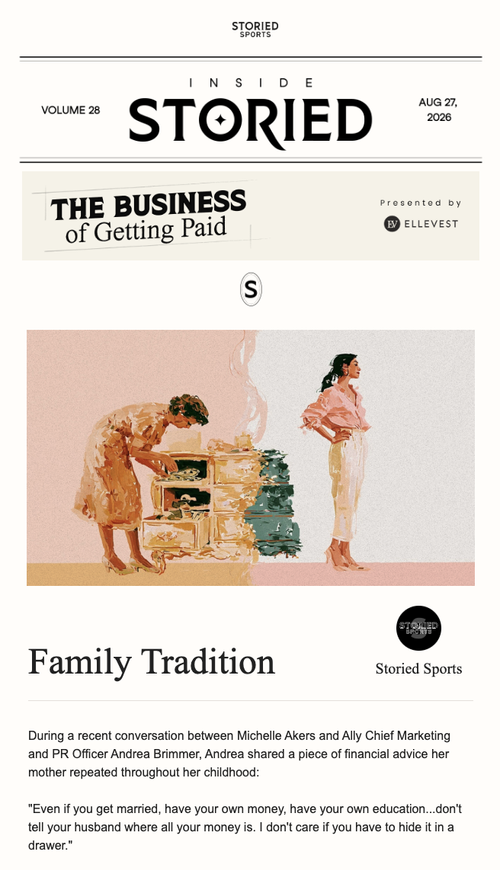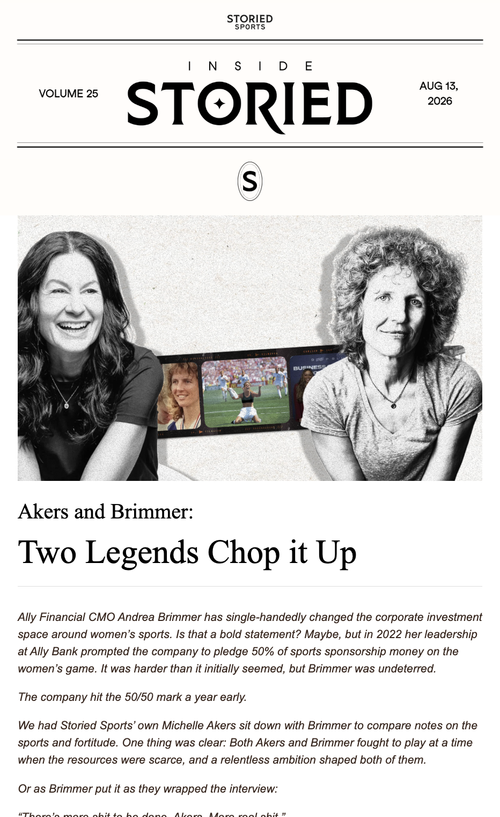
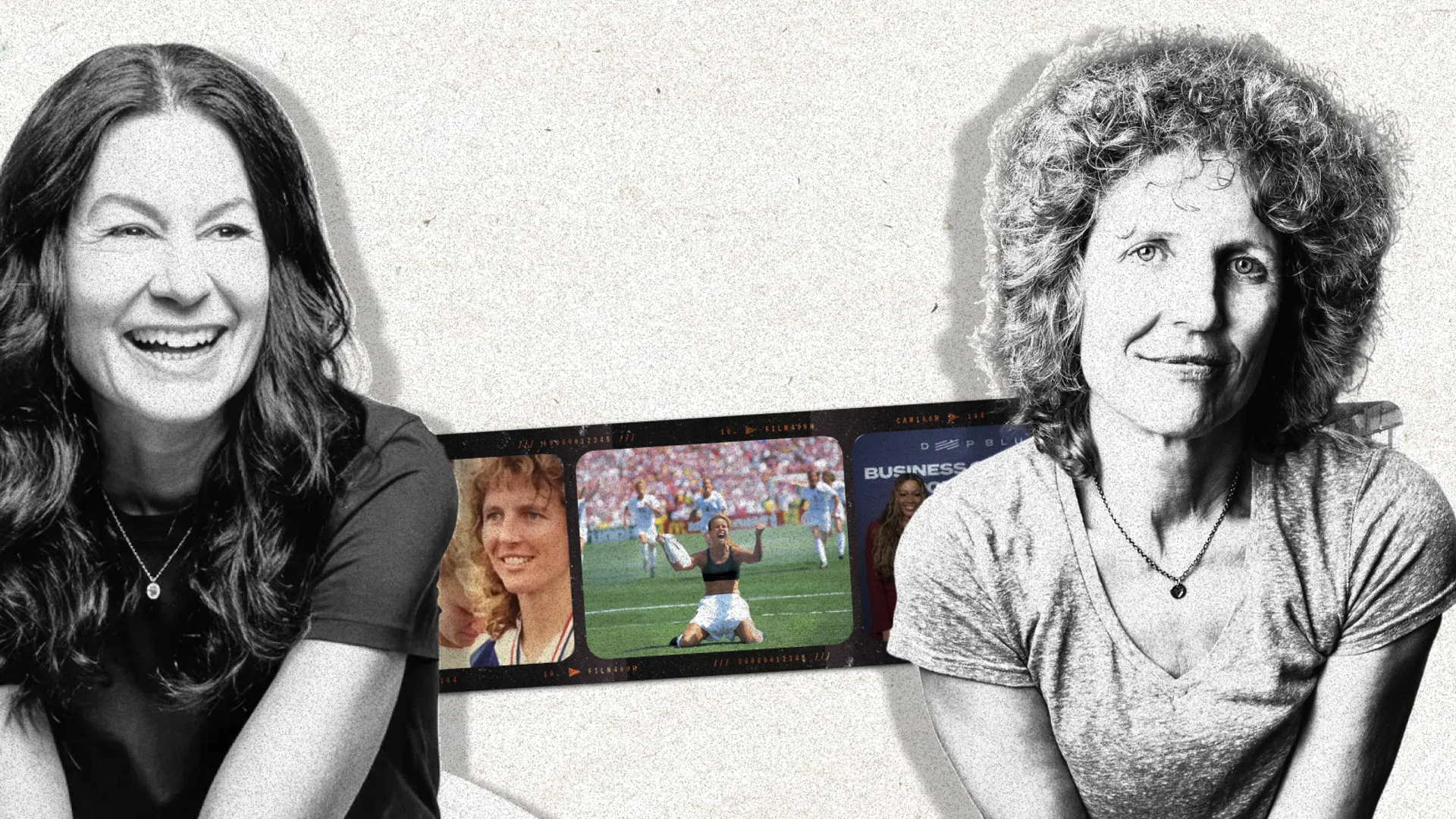

Ally Financial Chief Marketing and PR Officer Andrea Brimmer has single-handedly changed the corporate investment space around women’s sports. Is that a bold statement? Maybe, but in 2022 her leadership at Ally Bank prompted the company to pledge 50% of its sports media spend on the women’s game. It was harder than it initially seemed, but Brimmer was undeterred.
The company hit the 50/50 mark a year early.
We had Storied Sports’ own Michelle Akers sit down with Brimmer to compare notes on the sports and fortitude. One thing was clear: Both Akers and Brimmer fought to play at a time when the resources were scarce, and a relentless ambition shaped both of them.
Or as Brimmer put it as they wrapped the interview:
“There’s more shit to be done, Akers. More real shit.”
What follows is their conversation, lightly edited for clarity.
Michelle Akers: Let’s talk about our soccer careers. You sent me pictures of you playing in 1985 at Michigan State and in the same year you were striving to set up a varsity team there, I was on that first U.S. Women's National Team, also striving to build this varsity USA team. So we were both building something that wasn't there.
When you look back at where you were in 1985 on that field, did that fuel your vision for what is now?
Andrea Brimmer: I'm sure you probably felt the same way, Michelle, we were young, right? And you didn't know how important what you were doing was at the time. When I got to Michigan State, there was no varsity women's program. And a group of us just banded together and said, this should be a varsity sport, and we petitioned the athletic board, and we wrote presentations, and we got in front of the board, and we convinced them to make soccer a varsity sport and then worked across, the Big Ten at other schools to get varsity status for their women's teams. I didn't recognize the importance of it at the time. I thought I was just getting more people to be able to have an opportunity to do what I loved, which was to play soccer.
And there was no path for me once school ended. I didn't even know there was an ’85 national team at the time. And so, it wasn't until many years later where I drew upon a lot of the experiences of that time in my professional career. Especially when we were creating our women's sports strategy.
And then I started to connect dots around how empty I felt when I graduated, and something that I had done my whole life that was such a big part of me that I loved more than anything in the entire world was just taken from me, because there was nowhere to go with it.
That fueled me as a leader who had a seat at the table to be able to make systemic change, so that no girl would ever have to feel that again.
Michelle Akers: Female athletes have to not only show up and play and win, but they also have to figure out how to build the sport. For you and I, and so many others there wasn't anything there. There was no Olympics, there was no World Cup, there was no professional league, there was no place for us really to go. And if you think about it, you only missed that window by a few years.
Andrea Brimmer: Yeah.
Michelle Akers: It’s about leadership and having the courage to lead, and then also finding the people to do these almost impossible things. How do you think that's shaped you as a leader and then having this collaborative, kick-ass breaking-down-the walls, mindset?
Andrea Brimmer: I think my pedigree as a lifelong athlete, and especially a collegiate athlete, was the most formative thing that ever happened to me in my entire life. I was always pushed through sports to be in positions of pressure, to be in positions of leadership before I even thought I was ready.
In high school, I made the varsity team as a freshman. I was the first person in the history of my high school to do that. Our coach made me the captain in my sophomore year. We had seniors on the team.
Michelle Akers: Wow.
Andrea Brimmer: I was like oh my God, can’t be the captain, and she's like, ‘You can.’ And then the same thing has happened to me in my professional career, where I've been pushed into leadership positions before I thought it was ready, and it wasn't until I got older and wiser where I realized it was because of sports. It was because of that athlete pedigree. It was because of the bonds that I created with all these other women — never say die. Always push through, we're gonna figure this out.
That has made me the leader that I am, and it has brought me this intestinal fortitude of, I don't care how hard it is, I don't care how daunting it is, I don't care how enormous the task is, the end goal must be accomplished. And then surrounding myself with people that have that same mindset and fortitude.
Michelle Akers: Wow. Do you still play at all?
Andrea Brimmer: No, I really don't. You know what was funny, Michelle, is I played for a long time, and it just wasn't competitive enough for me.
Michelle Akers: I know. I was talking to (fellow Storied Sports teammate) Angela Ruggerio. I was like, God, I wish I played hockey so then I could just hit people and not get a red card. How fun would that be?
Andrea Brimmer: (Laughs) I was going to work with black eye, or a giant strawberry, or my knee is completely scraped. I'm like, I've got too big of a job to go to work with a black eye. I can't do this anymore!